You’ve just received a letter from your ex, a court date is looming, or perhaps you’re desperately trying to see your kids and suddenly, the question hits:
“Do I Need a Solicitor for Family Court?“
With emotions already high, the idea of legal costs only adds more pressure. But here’s the truth: a solicitor is not always necessary. And in many cases, you can still get support without the price tag.
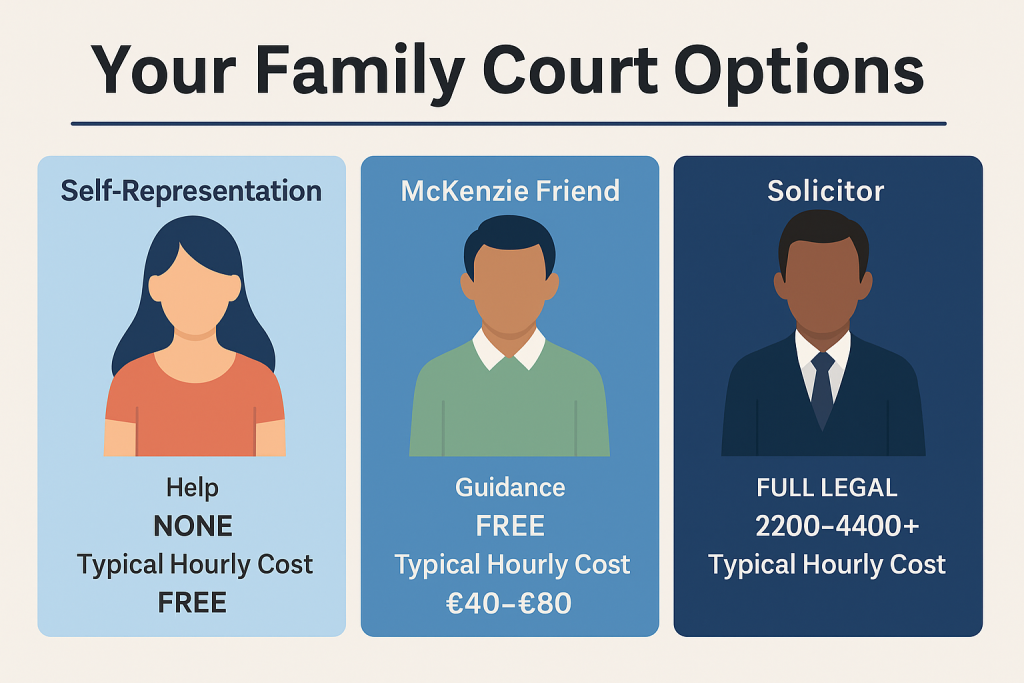
Understanding Your Options: Solicitor, McKenzie Friend, or DIY?
Family court in England and Wales is designed to be accessible to everyone, not just those who can afford legal representation. While solicitors can provide expert advice and handle the heavy lifting, they’re not legally required for most private family law matters — including:
- Child arrangement orders
- Prohibited steps orders
- Specific issue orders
- Non-molestation or occupation orders
- Enforcement proceedings
You have the right to represent yourself (known as a litigant in person), and many people do. But that doesn’t mean you have to face the system completely alone.
Enter the McKenzie Friend: Affordable Support, Real Impact
A McKenzie Friend is someone who can support you in court by:
- Helping prepare documents and statements
- Offering guidance on court procedures
- Taking notes and prompting you in hearings
- Sitting beside you for moral and procedural support
While they’re not legally qualified (and can’t speak on your behalf unless granted permission), many McKenzie Friends are highly experienced in family court matters, having supported dozens of similar cases.
💡 Cost: Typically between £40–£80 per hour — a fraction of the £200–£400/hour charged by solicitors.
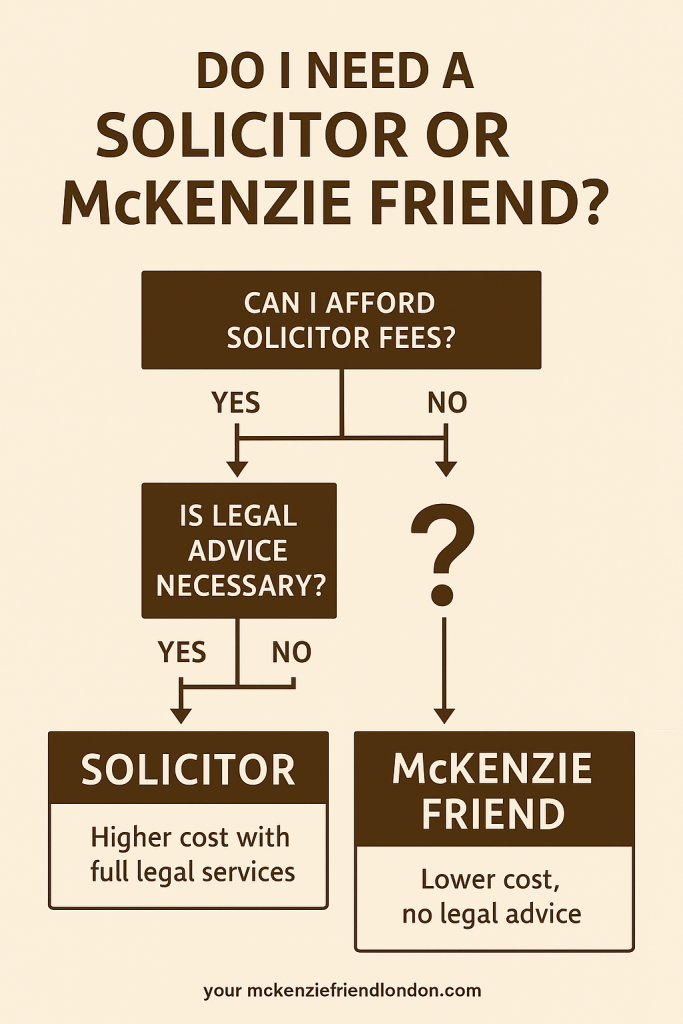
When a Solicitor Is the Better Option
There are situations where having a solicitor is recommended — even critical:
- Your ex has legal representation and is very aggressive
- Complex financial disputes or safeguarding issues are involved
- You’re unable to handle paperwork, deadlines, or cross-examination
- Your case may escalate to higher courts or involve appeals
Still, even in these cases, a hybrid approach can work — e.g., using a McKenzie Friend for support and reserving solicitor costs for key moments.
Family Court Support Options Compared
| Support Type | Legally Qualified | Can Speak in Court | Typical Hourly Cost | Best For |
|---|---|---|---|---|
| Self-Representation | ❌ No | ✅ You, if confident | £0 | Confident DIY, very simple cases |
| McKenzie Friend | ❌ No | ❌ Only with permission | £40–£80 | Affordable guidance, emotional support |
| Solicitor | ✅ Yes | ✅ Yes (lower courts) | £200–£400+ | Complex cases, negotiations, paperwork |
| Barrister (Direct Access) | ✅ Yes | ✅ Yes (all courts) | £250–£600+ | Final hearings, legal arguments, appeals |
Why So Many Parents Now Choose McKenzie Friends
In recent years, more and more parents — especially fathers — are turning to McKenzie Friends because:
- They feel overwhelmed but unheard
- Solicitor fees are simply unaffordable
- They want to stay actively involved in their case
- They’ve had negative past experiences with traditional representation
McKenzie Friends offer human support, not just legal know-how. We’ve seen clients walk in terrified and leave empowered, with a strategy in hand and a support system behind them.
Real Stories, Real Impact
“I was quoted £7,000 just for the first part of my case. Alex guided me for a fraction of that and helped me feel confident in court. I now have 50/50 shared time with my son.”
— T.L., West London Dad
So, Do You Need a Solicitor?
👉 Ask yourself:
- Can I speak confidently in front of a judge?
- Is my case relatively straightforward?
- Can I manage the paperwork with some support?
If yes, then no a solicitor is not essential. A trusted McKenzie Friend might be all you need. But if your case is especially complex or emotionally distressing, consider blending both options — or speaking to a solicitor just for a legal opinion.
Need Help Right Now?
We know how overwhelming this can feel. Whether you’re dealing with child contact issues, being kept from your children, or facing court for the first time, you don’t have to go through it alone.
📞 Call Alex on 07958 361168 or visit mckenziefriendlondon.co.uk
📩 Free 10-minute consultation — no pressure, just real support.
Disclaimer: This post is for informational purposes only and does not constitute legal advice.
━━━━━━━━━━━━━━━━━━━━━━━━━━━━━━
📄 Going It Alone? Our Template Packs Can Help
If you’ve decided to represent yourself, having the right documents makes all the difference. Our professional template packs are designed specifically for litigants in person:
- Position Statement Template Pack — 3 worked examples — £14.99
- Witness Statement Template Pack — PD17A compliant — £14.99
- C100 Application Guide — section-by-section walkthrough — £19.99
- Court Bundle Index & Cover — PD27A compliant — £7.99
Starting from £7.99. Designed by a practising McKenzie Friend and LLB law student.
👉 Browse all templates: mckenziefriendlondon.co.uk/resources