Navigating the family courts in the UK can be overwhelming, especially without legal representation. If you’re unable to afford a solicitor or simply prefer to handle your case yourself, a McKenzie Friend might be the support you need. But what exactly is a McKenzie Friend, and what can they legally do?
The Role of a McKenzie Friend
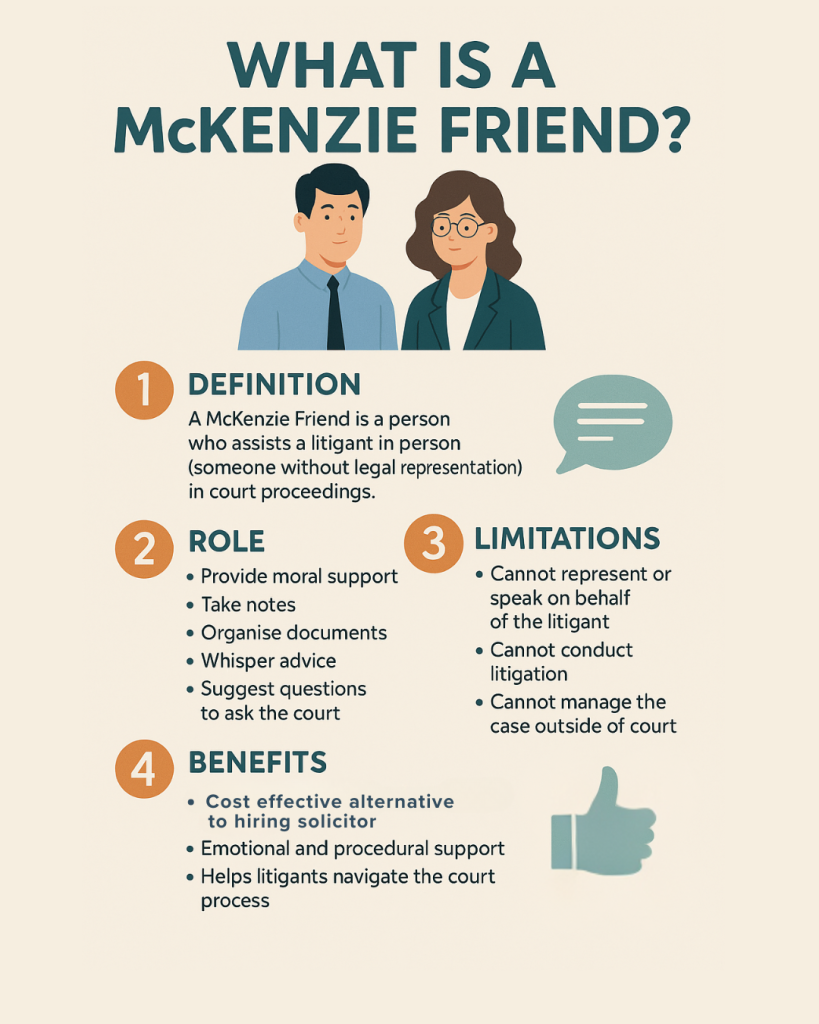
A McKenzie Friend is someone who assists you in court when you’re representing yourself (known as a litigant in person). While they are not legally qualified, their role is recognised by the courts and includes:
- Providing moral support and reassurance
- Taking notes during the hearing
- Helping organise case papers and evidence
- Quietly offering advice (e.g., points to raise or questions to ask)
Importantly, they cannot address the judge, cross-examine witnesses, or act as your formal legal representative unless given permission by the court.ght to address the court or examine witnesses, unless given express permission by the judge.
The Origin of the Term “McKenzie Friend”
The term comes from the landmark case McKenzie v McKenzie [1970] EWCA Civ 674, where the Court of Appeal ruled that a litigant in person had the right to receive reasonable assistance in court. This decision paved the way for what we now recognise as the modern McKenzie Friend.
Who Can Be a McKenzie Friend?
Anyone can act as a McKenzie Friend if they:
- Are not directly involved in the case (e.g., not a witness or party)
- Are not disruptive or working against the court’s interests
Many McKenzie Friends are experienced individuals who have extensive familiarity with family law and court processes, even if they are not legally trained or regulated.
When Would You Need a McKenzie Friend?
You might benefit from a McKenzie Friend if:
- You cannot afford a solicitor or barrister
- You feel confident representing yourself but want knowledgeable backup
- You suffer from stress, anxiety, or communication difficulties in court
- You’re involved in complex or emotionally difficult proceedings such as:
- Child arrangement orders
- Non-molestation orders
- Prohibited steps or specific issue orders
- Divorce and financial remedy hearings
What a McKenzie Friend Cannot Do
A McKenzie Friend does not have the right to:
- Speak to the judge or represent you in hearings (unless the court permits)
- Sign documents or correspondence on your behalf
- Take over conduct of your case
- Provide legal services unless specifically authorised
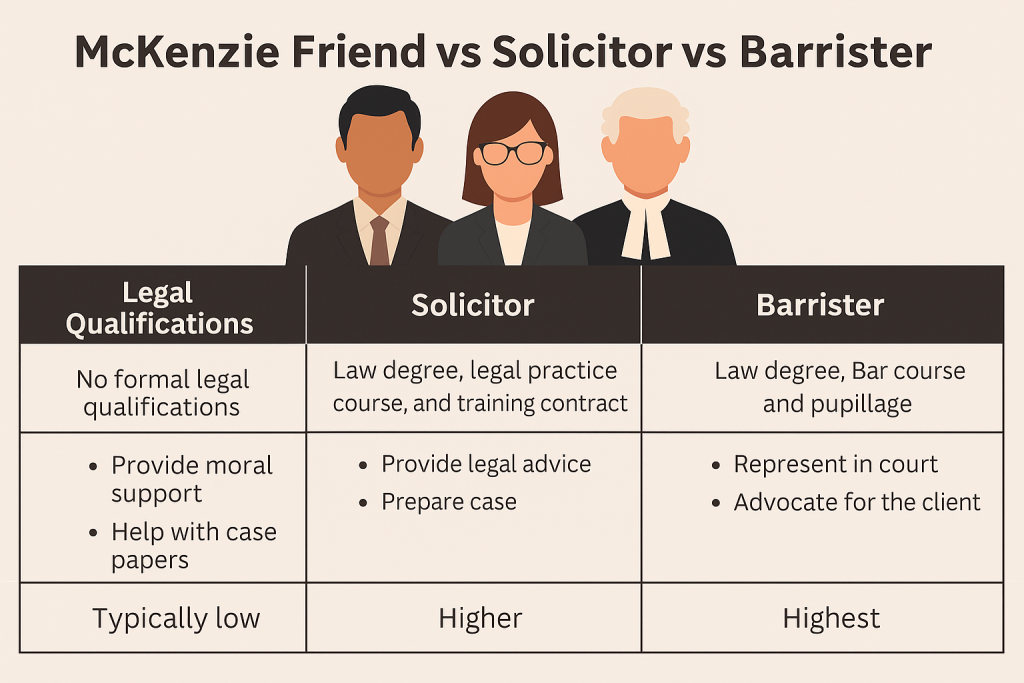
Benefits of Having a McKenzie Friend
- Affordable — usually much cheaper than instructing a solicitor or barrister
- Supportive — emotionally and practically reassuring
- Flexible — some offer evening or weekend support
- Organised — help with paperwork, forms, and preparation
Will the Judge Allow One?
Generally, yes. Judges often welcome the presence of a McKenzie Friend, provided they:
- Do not interrupt or behave inappropriately
- Do not give legal advice beyond their role
- Contribute to a smooth and fair hearing
If there are concerns about a McKenzie Friend’s conduct, the court can restrict or refuse their involvement — but this is rare when they behave professionally.
Final Thoughts
Representing yourself in family court doesn’t mean you’re on your own. With the right McKenzie Friend, you gain a calm, experienced presence who can help you stay focused, organised, and empowered.
If you’re involved in a family law case and need support, visit mckenziefriendlondon.co.uk or call 07958 361168 for a free, confidential discussion.
This article is intended for informational purposes only and does not constitute legal advice.
━━━━━━━━━━━━━━━━━━━━━━━━━━━━━━
📄 Representing Yourself? Get the Documents You Need
If you’re going to court without a solicitor, having the right documents can make all the difference:
- Position Statement Template Pack — 6 documents including 3 worked examples — £14.99
- Witness Statement Template Pack — 7 documents, PD17A compliant — £14.99
- C100 Application Guide — 5 documents, section-by-section walkthrough — £19.99
All templates are editable Word documents, designed by a practising McKenzie Friend and LLB law student, current to 2026.
👉 Browse all templates and hearing packs: mckenziefriendlondon.co.uk/resources